Penja pepper the volcanic spice of the Moungo valley
Penja pepper is Cameroon's most famous spice, grown on volcanic soils in the Moungo valley. Learn how white and black pepper are made, how they taste, and what the OAPI and EU protected geographical indications mean for buyers.
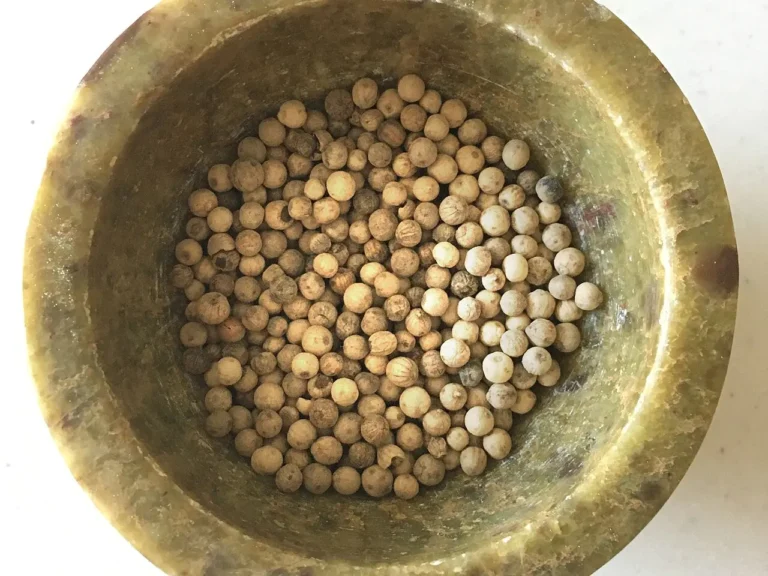
Penja pepper is Cameroon’s most famous spice, grown in the Moungo valley on soils born from old volcanoes. Chefs in Europe prize it, especially the white form, for its clean, warm heat and rich aroma.
Yet the name means more than a flavour. Since 2013, it has been a protected geographical indication in the OAPI zone. Since 2022, it has also been a protected name in the European Union. So the story of this pepper is part geology, part farming and part law.
This guide walks through all three. First, we explain where Penja pepper grows and why the soil matters. Then we compare white and black processing, look at flavour and kitchen uses, and unpack what PGI status means for buyers. Finally, we cover quality checks, buying tips and a short FAQ.
What is Penja pepper?
Penja pepper is pepper from the vine Piper nigrum, grown in a defined area of the Moungo valley in Cameroon’s Littoral region. The plant is the same species as pepper from India, Vietnam or Brazil. The difference lies in where and how it grows, and in how growers process the berries.
| Quick fact | Penja pepper |
|---|---|
| Plant | Piper nigrum, a climbing vine |
| Area | Moungo valley, Littoral region, around Penja, Njombé and Loum |
| Soil | Deep, well-drained soils formed from volcanic rock |
| Forms | White (best known) and black; green and red in small volumes |
| Harvest | About November to March |
| OAPI geographical indication | Registered in 2013 |
| EU protected geographical indication | Registered in 2022 |
| HS code (whole) | 0904.11, neither crushed nor ground |
In short, it is ordinary pepper in botany, but an unusual pepper in origin. That origin is what the protected name guards.
The Moungo valley: where Penja pepper grows
The town of Penja lies in the Moungo department, north of Douala. The valley sits below Mount Kupe and the Manengouba massif, on the Cameroon Volcanic Line. This chain of volcanoes runs from the Gulf of Guinea deep into Central Africa. Mount Cameroon, the highest peak in West and Central Africa, sits on the same line.
Volcanic soils
Over long periods, lava and ash from these volcanoes weathered into deep, dark soils. They are rich in minerals, drain well and hold plenty of organic matter. For a pepper vine, that is close to ideal. Roots need air and moisture at the same time, and waterlogging can rot them fast. Many growers and chefs link the depth of Penja pepper flavour to this soil.
Climate
The Moungo valley is hot and humid, with heavy rain for much of the year. A drier spell around the turn of the year helps flowering and harvest. Clean streams from the hills also matter, because white pepper needs a long soak in water. As a result, soil, rain and water all come together in one small area.
A banana valley that learned pepper
The Moungo valley is best known for bananas, and large plantations still line the roads. Pepper came later. Its local story is usually traced to the 1950s. At that time, a banana planter in Penja brought in vines, and a first small export of white pepper followed. Since then, smallholders and estates have grown the crop side by side.

From vine to berry: how Penja pepper is farmed
Pepper is a perennial vine. Growers train it up wooden posts or living trees, often to a height of a few metres. A young vine takes about three years to bear a useful crop. After that, a healthy vine can produce for many years with care.
The vines flower on long, thin spikes. Each spike then carries dozens of small berries that ripen from green to yellow and finally red. Harvest runs from about November to March. Pickers work by hand, because berries on one vine do not all ripen at once. Our Cameroon harvest calendar shows this window next to coffee, cocoa and ginger.
Most growers are smallholders, though some farms are larger. Many farmers also grow bananas, cocoa or food crops nearby. So, like much of Cameroon’s farm trade, Penja pepper reaches buyers through producer groups and aggregators who pool many small lots.
Challenges in the field
Pepper is not an easy crop. Like pepper vines everywhere, Moungo valley vines can suffer root and foot rot in wet soil, so drainage and healthy planting stock matter. Supports must be kept strong, because a heavy vine can pull down a weak post. In addition, picking is slow work, since pickers return to the same vine several times. All this explains why growers guard the reputation of the name so closely.
White vs black Penja pepper: two processing paths
Black and white pepper come from the same vine. The difference is when the berries are picked and how they are treated afterwards. This is the heart of the Penja pepper story, because the white form made the name famous.
How black pepper is made
- Picking: spikes are picked when the berries are mature but still green, often with a few turning yellow.
- Threshing: the berries are stripped from the spikes by hand or by simple machines.
- Drying: the berries dry in the sun for several days. Their skins wrinkle and turn dark brown to black.
- Cleaning: light berries, stems and dust are removed, then the pepper is bagged.
How white pepper is made
- Picking: pickers wait until the berries are fully ripe, yellow to red.
- Soaking (retting): the berries soak in sacks in clean water for about a week, so the outer skin softens.
- Rubbing and washing: workers rub off the softened skin and wash the seeds clean.
- Drying: the bare seeds dry in the sun until they turn cream to grey-white.
| Feature | Black pepper | White pepper |
|---|---|---|
| Harvest stage | Mature green | Fully ripe, yellow to red |
| Skin | Kept, dried dark | Removed after soaking |
| Colour | Dark brown to black | Cream to grey-white |
| Flavour | Bolder, more aromatic, woody | Cleaner, softer, with a lasting heat |
| Typical moisture limit | About 12% max. | About 13% max. |
| Typical bulk density | About 500–570 g/L | About 600 g/L min. |
| Extra work | Lower | Higher: soaking, rubbing, washing |
White pepper loses weight with its skin, and it needs more labour and water. Therefore it usually costs more than black pepper from the same farm. However, the soak also brings risk. Stale or dirty water can leave a musty, farmyard note. So careful retting is a mark of good white pepper.
Penja pepper flavour and kitchen uses
Taste is the reason chefs seek out Penja pepper. Of course, every lot is a little different. Still, a few notes come up again and again.
White in the kitchen
White Penja pepper is often described as musky, warm and floral, with a heat that builds slowly and lasts. It lacks the harsh, sharp edge of some white peppers. Chefs like it on fish, white sauces, mashed potatoes, eggs and pale soups, where black flecks would spoil the look. Pastry chefs also use it with chocolate, strawberries or pineapple.
Black in the kitchen
Black pepper from the Moungo valley is bolder and more aromatic, with woody, fresh notes. It suits grilled meat, stews, sauces and steaks. Because the skin holds much of the aroma oil, black pepper smells stronger than white when freshly ground.
Tips for keeping flavour
- Buy whole berries and grind them just before use.
- Store pepper in airtight, opaque containers away from heat.
- Add white pepper near the end of cooking to keep its aroma.
For food makers and spice packers, these traits matter as well. Volatile oil and piperine content drive aroma and heat, so many buyers ask for lab results with each lot.

Penja pepper PGI status explained
A geographical indication, or GI, is a name tied to a place. It tells buyers that a product comes from that area and has qualities linked to it. Champagne, Parma ham and Darjeeling tea are well-known examples. Penja pepper belongs to the same family of protected names.
OAPI registration in 2013
OAPI, the African Intellectual Property Organization, covers 17 member states, mostly in West and Central Africa. In 2013, it registered Penja pepper as a geographical indication. It was one of the first two GIs that OAPI registered, alongside Oku white honey, also from Cameroon. You can read more about the system on the OAPI website.
EU registration in 2022
In March 2022, the European Commission registered “Poivre de Penja” as a protected geographical indication in the EU. It was the first product from the OAPI zone to gain an EU GI. As a result, only pepper that meets the registered specification may use the name on the EU market.
What PGI means in practice
- A defined area: the pepper must be grown and processed inside the registered zone.
- A written specification: it sets out how the pepper is grown, harvested, processed and packed.
- Controls: producers who use the name follow the scheme’s checks and records.
- Labelling rules: only compliant lots may carry the protected name and, in the EU, the PGI logo.
For buyers, the PGI label adds trust and a clear story on the shelf. However, it also brings extra paperwork, limited volumes and a premium price. So it suits some markets better than others.
Why GIs matter to growers
A protected name helps a region keep the value of its reputation. Without it, pepper from anywhere could be sold under a famous local name. With it, the growers who built that reputation keep the right to use it. As a result, GIs can support fair returns, careful farming and local know-how. They also give buyers a simple way to check that a story is true.
Our standard lots and the Penja name: a clear position
We want to be clear about what we offer. BV Holdings Agro sources pepper from the Moungo valley, around Penja, Njombé and Loum. However, we do not sell our standard lots as PGI-certified. We also do not use the protected Penja pepper name on them.
Instead, our standard lots trade as Cameroon white pepper and Cameroon black pepper, with a stated region of origin. They are graded on moisture, bulk density, light berries, foreign matter and volatile oil. That suits food makers, grinders and importers who want Moungo valley pepper on clear specs.
If your market needs the protected name, tell us in your inquiry. PGI-labelled lots can be discussed on request, subject to availability and to the scheme’s own rules and papers. In that case, the label, price and documents follow the PGI scheme, not our standard terms.
Quality checks before loading
Whatever the label, a pepper lot is judged in the lab and by the nose. Our checks follow the steps on our quality and sourcing page. We buy in region, dry and store, then sample and test. Finally, we clean and pack, inspect and load.
- Moisture: damp pepper grows mould at sea, so every lot is tested.
- Bulk density: heavier berries usually mean better-filled pepper.
- Light berries and pinheads: hollow or undersized berries add weight but little flavour.
- Extraneous matter: stems, stones and dust are removed by cleaning.
- Volatile oil: a guide to aroma strength, tested on request.
- Microbes and mycotoxins: important for white pepper, because retting uses water.
- Smell: each sample is checked for musty or off-notes.
Many buyers also ask for tests against EU limits on pesticide residues, aflatoxin and ochratoxin A. In addition, an independent inspection company can be nominated by the buyer. Results then travel with the export papers listed on our documents page.
Buying tips for Penja pepper and Moungo valley pepper
Whether you want the protected name or simply good pepper from the area, these quick picks help you brief a supplier.
- Chef and gourmet brands: ask about PGI-labelled lots, and check the label rules for your market.
- Spice grinders and packers: standard white or black lots on clear specs often give better value.
- Food manufacturers: state volatile oil, microbial and mycotoxin limits in the contract.
- White pepper buyers: ask how the lot was retted and dried, and smell the sample.
- Black pepper buyers: set a bulk density and light berry limit, because both affect yield.
- New buyers: start with one 20ft container, then scale once the lot fits your plant.
Also, compare offers on the same Incoterm. A CIF price to Rotterdam is not the same as FOB Douala, so line up the terms first.
Exporting pepper from the Moungo valley: packing, papers and ports
Our spices ship from Douala or Kribi on FOB, CFR or CIF terms. Pepper is packed in new 25 kg jute or PP bags, with inner liners where required. Bags carry export marks and a lot number, so each lot can be traced back to its checks.
A standard shipment comes with a commercial invoice, packing list, bill of lading, phytosanitary certificate and certificate of origin. A weight and quality certificate from the agreed inspection company is added too. Fumigation and lab reports follow where your market or contract requires them.
Pepper also sits well with other spices in a mixed plan. For example, many buyers source Cameroon ginger from the same season. You can see the full spices range for other options. Our export process then runs from inquiry to offer and sample, contract, payment security, preparation and shipment.
FAQ: Penja pepper
What makes Penja pepper special?
It grows in a small part of the Moungo valley in Cameroon’s Littoral region, on deep soils formed from volcanic rock. The hot, humid climate and clean water for retting also play a part. Chefs value the white form for its clean, musky heat. The name is protected as a geographical indication in the OAPI zone and the EU.
When did Penja pepper get PGI status?
OAPI, the African Intellectual Property Organization, registered it as a geographical indication in 2013. It was one of the first two GIs in the OAPI system, with Oku white honey. Then, in March 2022, the European Commission registered “Poivre de Penja” as a protected geographical indication in the European Union.
Is white Penja pepper different from black?
Both come from the same vine. Black pepper is picked mature green and sun-dried with its skin, so it turns dark and tastes bolder. White pepper is picked fully ripe, soaked for about a week, rubbed clean of its skin and dried. It looks cream to grey-white and tastes cleaner, with a lasting heat.
Is your pepper PGI-certified Penja pepper?
No. Our standard lots come from the Moungo valley. However, we do not sell them as PGI-certified, and we do not use the protected name on them. They trade as Cameroon white or black pepper with a stated origin. PGI-labelled lots can be discussed on request, subject to availability and the scheme’s own rules.
Why does white pepper cost more than black?
White pepper takes more work and more fruit. Growers wait for full ripeness, soak the berries, rub off the skins, wash them and dry them again. The skin also carries weight, so each kilo of white pepper needs more fresh berries. As a result, white pepper usually trades at a premium to black.
How should Penja pepper be stored?
Keep whole berries dry, cool and away from light, in airtight containers or lined bags. Moisture invites mould, while heat and air slowly drain the aroma. Whole pepper keeps its flavour far longer than ground pepper. So grind it just before use, or as close to packing as possible for retail brands.
What tests should I ask for?
Start with moisture, bulk density, light berries and extraneous matter. Then add volatile oil if aroma matters to you. For white pepper, also ask for microbiological tests, because retting uses water. EU buyers often add aflatoxin, ochratoxin A and pesticide residue tests. An inspection company you nominate can check the lot before loading.
What is the minimum order for Moungo valley pepper?
Our minimum order is one 20ft container. Larger buyers can order several containers or mix white and black pepper lots in one plan, subject to supply. Tell us the form, volume, specification, Incoterm and port in your inquiry. We then reply with an offer and arrange samples before you sign.

One arm of BV Holdings PLC
BV Holdings Agro is the agricultural export company of BV Holdings PLC, alongside BV Cocoa Products and BV Metal & Minerals.
Source pepper from the Moungo valley
Share your form, specs, volume and port, and we will send an offer with samples of Cameroon white or black pepper.