Arabica vs Robusta coffee a buyer's guide from Cameroon
Arabica vs Robusta coffee is the first choice every green coffee buyer makes. This guide compares the two beans as Cameroon grows them, from highland and lowland farms to cup profile, caffeine, screen sizes and the best fit for your product.

Arabica vs Robusta coffee is the first choice every green coffee buyer makes. Cameroon grows both. Arabica comes from the cool western highlands. Robusta, meanwhile, grows in the warm lowlands and forest zones further south and east.
The two beans look alike in a sack, yet they behave very differently in a roaster and in a cup. They differ in taste, caffeine, sugar, bean size, processing and price. So the right pick depends on what you make and who drinks it.
This Arabica vs Robusta coffee guide explains the differences in plain English. First, we cover the botany and where each bean grows in Cameroon. Then we compare cup profile, chemistry, screen sizes and uses. Finally, we give quick picks for common buyers, plus a short FAQ.
Arabica vs Robusta coffee: the short answer
If you only have one minute, the table below sums up Arabica vs Robusta coffee from a buyer’s point of view. The values are typical ranges from the coffee literature and the trade. Each lot still differs by farm, altitude, season and process.
| Feature | Arabica | Robusta |
|---|---|---|
| Species | Coffea arabica | Coffea canephora |
| Where it grows in Cameroon | West and North-West highlands | Littoral (Moungo), South-West, East, Centre |
| Typical altitude | About 1,200 to 2,000 m | Lowlands, mostly below about 1,000 m |
| Usual process | Washed | Natural (dry processed) |
| Cup profile | Sweeter, brighter, more aroma | Fuller body, bitter, earthy, nutty |
| Caffeine (green bean) | About 1.1% to 1.5% | About 2.0% to 2.7% |
| Common screens | 15+, 16+, 17+ | 18 (Grade 1), 16 (Grade 2), 14 |
| Main uses | Specialty, single origin, premium blends | Espresso blends, instant coffee, value blends |
| Harvest in Cameroon | About October to January | About November to February |
In short, Arabica sells on flavour, while Robusta sells on body, strength and value. However, the best blends often use both.
Two species, two family trees
Coffee is not one plant. Arabica and Robusta are two separate species in the same genus, Coffea. Their family history explains much of the Arabica vs Robusta coffee gap in the cup.
Arabica: the highland self-pollinator
Arabica first grew wild in the highland forests of Ethiopia and nearby areas. It carries four sets of chromosomes, which is unusual for coffee. It also pollinates itself, so a single tree can set fruit alone. As a result, Arabica has low genetic diversity. That makes it more prone to pests and disease, such as leaf rust and coffee berry disease.
Robusta: the tough lowland cousin
Robusta is the common name for Coffea canephora. It grows wild in the forests of West and Central Africa, a range that includes Cameroon. Unlike Arabica, it needs pollen from other trees to set fruit. Therefore its gene pool is wide and varied. The name says the rest: Robusta is hardy, high-yielding and copes better with heat and disease.
These traits matter for supply. Robusta usually gives more coffee per hectare at a lower cost. Arabica, by contrast, asks for altitude, care and cooler nights. That is one reason the Arabica vs Robusta coffee price gap exists at all.

Arabica vs Robusta coffee in Cameroon: where each grows
Cameroon has seven coffee-growing regions: West, North-West, Littoral, South-West, South, Centre and East. So for the Arabica vs Robusta coffee choice, geography matters. Robusta makes up most of the national crop. Arabica is the smaller share, yet it has a loyal following among roasters.
Arabica in the western highlands
Cameroon Arabica grows on the high plateaus of the West and North-West regions. Farms sit on rich volcanic soils, often at about 1,200 to 2,000 metres. In the West, growing areas include the Bamileke plateau around Dschang and the Noun area around Foumbot. In the North-West, coffee grows around Bamenda, Santa, Ndop and Kumbo.
Coffee reached the western highlands in the late 1920s, when a research station at Dschang began planting seedlings. Today, Java and Jamaica are the main Arabica varieties. Java is valued for its resistance to coffee berry disease. Cool nights slow the ripening, so the beans build more sugar and acidity.
Robusta in the lowlands and forest zones
Robusta grows at lower and middle altitudes, where it is warm and humid. The Moungo valley in the Littoral region is a key area, around Nkongsamba, Melong and Loum. The South-West region also grows Robusta, and so does the East around Abong-Mbang and Bertoua. Parts of the Centre and South add smaller volumes.
Most farms in both zones are small family plots. Many farmers also grow cocoa, plantain or food crops on the same land. So one export lot usually combines beans from many growers. Producer groups and aggregators collect the coffee, and exporters such as BV Holdings Agro consolidate it into container lots.
Harvest timing
Arabica in Cameroon is picked from about October to January. Robusta follows from about November to February. Because the seasons overlap, a buyer can plan both beans in the same shipping window. Our Cameroon harvest calendar shows these windows next to cocoa, pepper and other crops.
Cup profile: how Arabica and Robusta taste
Taste is where Arabica vs Robusta coffee becomes personal. Still, cuppers describe the two in fairly consistent terms.
Arabica in the cup
Good washed Arabica is sweet and clean, with bright acidity and a lot of aroma. Cameroon highland Arabica is often described with notes of chocolate, caramel, citrus or soft fruit. The body is medium, so the flavour stays clear in filter coffee. As a result, roasters can sell it as a single origin or use it to lift a premium blend.
Robusta in the cup
Robusta tastes stronger and more bitter. Typical notes are earthy, woody, nutty or dark chocolate. It has a heavy body and less acidity. In espresso, it builds a thick, lasting crema. A well-processed, clean Robusta can also be smooth and pleasant on its own. However, poor drying can add harsh, rubbery or mouldy notes, so lot quality matters a great deal.
What changes the flavour
Species sets the base of the Arabica vs Robusta coffee contrast, but other factors shape the final cup. Altitude, soil, ripeness at picking, drying speed and storage all play a part. For this reason, we always send a sample before you sign. Your roaster can then cup the lot and judge it against your own standard.
Caffeine, sugar and oils: Arabica vs Robusta coffee by the numbers
Chemistry explains a lot of the taste gap. The table shows typical ranges for green beans on a dry basis. They come from general coffee science, not from tests on a single lot.
| Component (green bean, dry basis) | Arabica | Robusta | What it does |
|---|---|---|---|
| Caffeine | About 1.1–1.5% | About 2.0–2.7% | Bitterness and stimulant effect |
| Sucrose | About 6–9% | About 3–7% | Sweetness and caramel notes after roasting |
| Lipids (oils) | About 15–17% | About 10–12% | Mouthfeel and aroma carry |
| Chlorogenic acids | About 5–8% | About 7–10% | Bitterness, astringency and some acidity |
Two points stand out. First, Robusta carries roughly double the caffeine of Arabica. Caffeine is bitter, and it also helps protect the plant from insects. Second, Arabica has more sugar and oil. Sugar turns into caramel and fruity notes in the roaster, while oils carry aroma to the nose.
So in Arabica vs Robusta coffee chemistry, Robusta gives more kick per bean. For a sweet, aromatic cup, Arabica usually wins. Meanwhile, many buyers simply blend the two to get both.
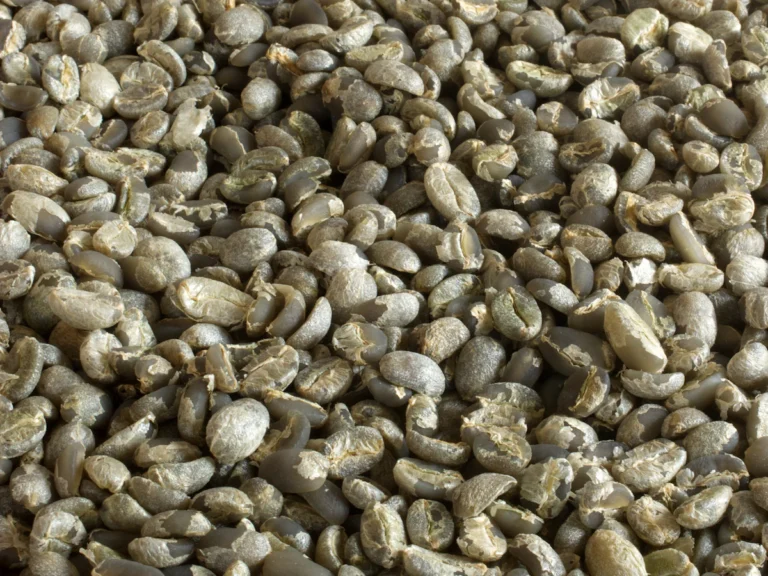
Washed vs natural: how Cameroon processes each bean
After picking, the fruit must be removed and the bean dried. Cameroon uses two main methods, and they match the Arabica vs Robusta coffee split quite closely.
- Washed (wet) process, mostly Arabica: farmers remove the skin and pulp, ferment the beans briefly, then wash and dry them. The result is a clean, bright cup.
- Natural (dry) process, mostly Robusta: the whole cherry dries in the sun, then the dried husk is removed by hulling. The cup is heavier and more rustic.
Natural Arabica and washed Robusta exist too, but they are smaller niches. If you need one, ask in your inquiry. Washed Robusta usually costs more than natural Robusta of the same screen, because the process takes more work and water.
Why drying matters
Green coffee must reach about 10% to 12.5% moisture for safe storage and shipping. Wet beans can grow mould and lose quality at sea. Over-dry beans, on the other hand, can turn brittle and lose flavour. Therefore we check moisture on every lot before loading, as our quality and sourcing page explains.
Screen sizes and grades explained
Green coffee is graded by bean size and by defects. Size is measured with screens: metal sieves with round holes. The screen number is the hole size in 64ths of an inch. So a screen 18 bean stays on a sieve with holes of 18/64 of an inch, about 7.1 mm.
| Screen | Hole size (approx.) | Typical Cameroon use |
|---|---|---|
| 18 | 7.1 mm | Robusta Grade 1: large, even beans |
| 17+ | 6.7 mm | Arabica top grade for specialty and single origin |
| 16 / 16+ | 6.4 mm | Robusta Grade 2; Arabica mid grade for premium blends |
| 15+ | 6.0 mm | Arabica standard grade for commercial blends |
| 14 | 5.6 mm | Smaller Robusta for soluble coffee, by contract |
Bigger beans are not always tastier. However, an even screen roasts evenly, and roasters pay for that. Defects are the second half of the grade. Black beans, broken beans, insect damage and foreign matter all count against a lot. For example, a Robusta contract may cap black and broken beans at about 3% to 5%.
The screen numbers are the same for both species, yet the Arabica vs Robusta coffee grade names differ by origin. That is why each contract should state the screen, the defect limit and the test method in plain words.
Uses: who buys which bean
Different buyers lean on different strengths. Here is how the Arabica vs Robusta coffee split usually works across the trade.
- Specialty roasters: mostly Arabica, from top screens, for single-origin filter and espresso.
- Espresso and Italian-style roasters: often a blend, with Robusta for crema, body and strength.
- Instant coffee makers: mostly Robusta, because it gives a high yield of soluble solids at a good cost.
- Supermarket and private-label brands: both, blended to hit a price point and a steady taste.
- Green coffee importers and traders: both, in container lots for resale to smaller roasters.
- Ready-to-drink and food makers: often Robusta or blends, for extracts and flavour strength.
Cameroon Robusta also has a long history with European blenders, including buyers in Italy and Belgium. Cameroon Arabica, meanwhile, finds homes with roasters who want an African origin with a sweet, rounded cup.
Arabica vs Robusta coffee: which should you buy?
There is no single winner in the Arabica vs Robusta coffee contest. Instead, the right choice follows your product. These quick picks cover the most common cases.
- You sell single-origin or specialty coffee: choose washed Arabica at screen 16+ or 17+. Ask for a cupping sample first.
- You roast espresso blends: buy both. A share of Robusta Grade 1 or Grade 2 adds crema and body to an Arabica base.
- You make instant or soluble coffee: choose natural Robusta. Smaller screens such as 14 can give good value.
- Your house blend must be strong and low-cost: lean on Robusta, then add some Arabica for aroma.
- Your product needs high caffeine: Robusta, because it carries roughly twice the caffeine.
- You are testing a new origin: start with one 20ft container of the bean you know best, then expand.
Still weighing Arabica vs Robusta coffee? Tell us your product, roast style and target market. We will suggest a grade and send samples of the Arabica vs Robusta coffee options that fit.
How Arabica vs Robusta coffee prices are set
The two beans trade on separate futures markets. Arabica follows the ICE “C” contract in New York, quoted in US cents per pound. Robusta follows the ICE Robusta contract in London, quoted in US dollars per tonne. Each physical lot then trades at a differential above or below the futures price.
In practice, the Arabica vs Robusta coffee price gap shifts with each season’s crop. Several factors move an offer. They include the futures level, the grade and screen, defects, process, crop year and the Incoterm. Freight, insurance and the destination port matter too. So compare offers on the same basis, such as FOB Douala or CIF to your port. Our FOB vs CIF guide explains the difference.
We do not publish prices, because they change with the market every day. Instead, each offer states the grade, Incoterm, port and validity. The International Coffee Organization also publishes market reports that many buyers follow.
Buying Cameroon green coffee from BV Holdings Agro
BV Holdings Agro is a Cameroon export trading house and part of BV Holdings PLC. We supply both sides of the Arabica vs Robusta coffee choice in our green coffee range, in full container loads.
- Green Arabica coffee: washed, from the West and North-West highlands, in screens 15+, 16+ and 17+.
- Green Robusta coffee: natural, from the Littoral, South-West and East, in Grade 1 (screen 18) and Grade 2 (screen 16).
- Packing: new 60 kg jute bags; about 320 bags, or roughly 19.2 tonnes, fit a 20ft container.
- Ports and terms: loading at Douala or Kribi, on FOB, CFR or CIF terms.
- Checks: moisture, screen and defect checks before loading; independent inspection on request.
- Papers: full export documents, including the ONCC export quality certificate.
Coffee export lots in Cameroon are subject to quality control by the National Cocoa and Coffee Board (ONCC). Coffee also falls under the EU Deforestation Regulation, so EU buyers should plan their due diligence early. Our export process runs from inquiry to offer and sample, then contract, payment security, preparation and shipment.
FAQ: Arabica vs Robusta coffee
What is the main difference in Arabica vs Robusta coffee?
They are two different species. Arabica (Coffea arabica) grows at altitude and gives a sweeter, more aromatic cup with less caffeine. Robusta (Coffea canephora) grows in warmer lowlands, yields more and gives a stronger, more bitter cup with about twice the caffeine. In Cameroon, Arabica comes from the western highlands and Robusta from the Littoral, South-West and East.
Does Robusta really have more caffeine than Arabica?
Yes. Green Robusta typically holds about 2.0% to 2.7% caffeine on a dry basis, while Arabica holds about 1.1% to 1.5%. So Robusta carries roughly double. That extra caffeine adds bitterness and strength, which is one reason Robusta is popular in espresso blends and in instant coffee.
Where is Arabica grown in Cameroon?
Cameroon Arabica grows on the high plateaus of the West and North-West regions, often at about 1,200 to 2,000 metres. Growing areas include the Bamileke plateau around Dschang, the Noun area around Foumbot, and the highlands around Bamenda, Ndop and Kumbo. Rich volcanic soil and cool nights help the beans build sweetness and acidity.
Where is Robusta grown in Cameroon?
Robusta grows in warm, humid lowland and forest zones. The Moungo valley in the Littoral region is a key area, around Nkongsamba, Melong and Loum. The South-West and East regions also grow Robusta, with smaller volumes from the Centre and South. Robusta makes up most of Cameroon’s coffee crop.
What do coffee screen sizes mean?
A screen number is the size of the holes in a grading sieve, measured in 64ths of an inch. For example, screen 18 means holes of 18/64 of an inch, about 7.1 mm. Beans that stay on that sieve count as screen 18. Larger, even screens roast more evenly and usually earn a better price.
Which is better for espresso in the Arabica vs Robusta coffee choice?
Many roasters use both. Arabica gives sweetness and aroma, while Robusta adds body, strength and a thick crema. A common approach is an Arabica base with a share of Robusta, set by taste and price. Pure Arabica espresso is also popular in specialty cafés, so the blend depends on your market.
Can I buy both sides of Arabica vs Robusta coffee in one shipment?
Often, yes. The Cameroon Arabica and Robusta harvests overlap, so both can be prepared in the same window. Each grade stays a separate lot with its own bags, marks and quality papers. Tell us the split you need in your inquiry, and we will confirm what fits in one or more containers.
How do I sample Arabica vs Robusta coffee from Cameroon?
Send an inquiry with the species, grade, volume, Incoterm and destination port. We then reply with an offer and arrange samples of the matching lots. Your roaster can cup them and check moisture and screen. Once you are happy, we agree the contract, and the shipment follows from Douala or Kribi.

One arm of BV Holdings PLC
BV Holdings Agro is the agricultural export company of BV Holdings PLC, alongside BV Cocoa Products and BV Metal & Minerals.
Compare both beans in your roaster
Tell us your grade, volume and port, and we will send an offer with Arabica and Robusta samples from Cameroon.